Unofficial, independent and occasionally sarcastic. Not affiliated with Gary Stevenson or Gary's Economics. Opinions are ours; factual claims link to their sources.

Independent criticism and satire

Gary's Fairy Economics

Big claims. Viral charts. Awkward questions.

Gary Stevenson built a huge audience by explaining Britain's economic problems in simple, confident terms. Sometimes he makes important points. Sometimes the story is considerably tidier than the evidence. This site looks at the claims, the gaps and the occasional economic fairy tale.

Fully re-checked

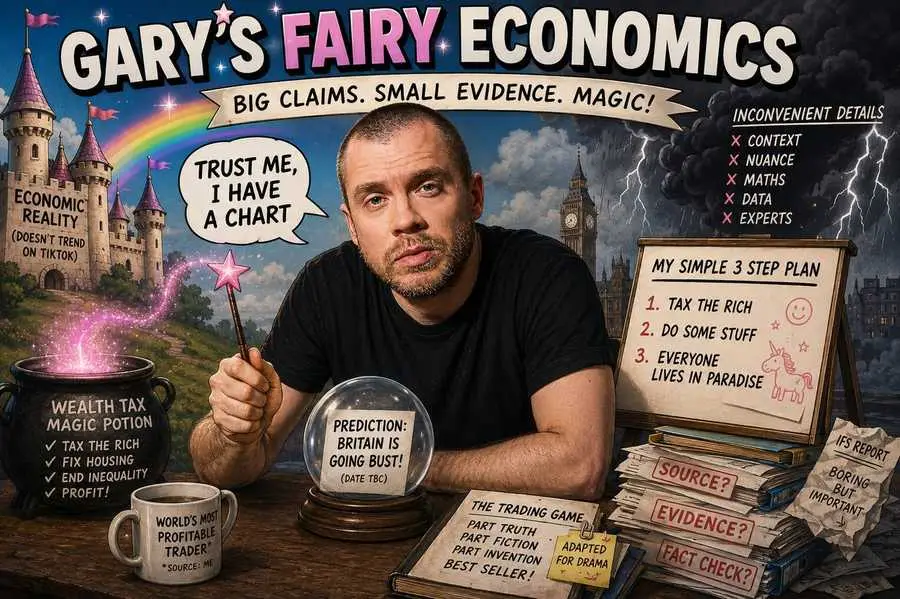
Satirical illustration: Gary Stevenson at a desk with a wand, a crystal ball and a speech bubble reading 'Trust me, I have a chart'
Satirical illustration. The speech bubble and props are our jokes, not his words.

The fairy tale and the reality check

The fairy tale

How the story is told.

  • "Citibank's most profitable trader, in the whole world": the working-class outsider who beat the system at its own game.
  • Author of The Trading Game, a No. 1 Sunday Times bestseller.
  • The campaigner with a simple fix for inequality: a 2% annual tax on wealth above £10m.
  • The YouTube economist, with 1.66m subscribers and over 250m views, who tells you what the establishment won't.

The reality check

What the evidence, critics and inconvenient details say.

  • Eight former Citi colleagues told the FT they disputed the "best trader" claim. Gary stands by it.
  • Kent Bray, described as his Citi mentor, has also publicly challenged it.
  • The IFS, Resolution Foundation and the UK Wealth Tax Commission all argue against an annual wealth tax on design grounds, and favour other ways to tax wealth.
  • He holds real economics degrees (LSE, Oxford). We have found no peer-reviewed research by him.

Sources: Financial Times, 12 Sep 2024; YouTube channel stats, read 25 Oct 2026; Penguin; Wikipedia

Rated one to five fairies

The Whopper Board

"Whopper" means a large or questionable claim, not a lie. These are the claims that do the heaviest lifting. Some have strong foundations. Others appear to have called in sick.

"Citibank's most profitable trader, in the whole world"

Disputed

The claim

Gary says he became Citi's most profitable trader globally in 2011.

The reality check

Citi publishes no league table. Eight former Citi colleagues told the Financial Times they disputed the claim and that the bank kept no official ranking of trader profitability. Citi's then global head of FX, Jeff Feig, said: "He wasn't even close to being one of the stars." Gary stands by what he wrote. Nobody disputes that he was a successful trader.

🧚🧚🧚🧚Impressive story. Receipts still pending.

Sources: Financial Times (FT Alphaville), 12 Sep 2024; eFinancialCareers, 25 Jun 2026; Wikipedia summary

<em>The Trading Game</em> as the straight story

Disputed

The claim

Gary's No. 1 Sunday Times bestselling memoir is presented as a confession: the true account of his rise at Citi.

The reality check

Memoirs are allowed to be dramatic. But former colleagues quoted by the FT disputed parts of the account, and ex-Citi trader Kent Bray, described as Gary's mentor at the bank, has publicly challenged the "best trader" claim. Readers are entitled to ask where memory ends and storytelling begins. The free-market IEA, no fan of his politics, noted it "doesn't really matter" whether he was literally the best.

🧚🧚🧚Possibly true. Definitely cinematic.

Sources: Financial Times (FT Alphaville), 12 Sep 2024; Disruptors podcast with Kent Bray, 12 May 2025; City AM, 18 Jun 2026; IEA book review

A 2% wealth tax above £10m fixes the problem

Partly supported

The claim

Gary's headline proposal, set out in his Channel 4 documentary, is a 2% annual tax on wealth above £10m.

The reality check

Taxing wealth more may well have a role, and serious economists support versions of it. The less magical questions are valuation, avoidance, migration, liquidity and how much it would raise. The OECD found 12 countries ran net wealth taxes in 1990 and only 4 by 2017. The UK Wealth Tax Commission judged an annual wealth tax inadvisable. Tax lawyer Dan Neidle called the plan "populist claptrap"; even Gary called Neidle's capital-flight point "a very good point". Read our full wealth-tax page.

🧚🧚Not fantasy. Just missing several difficult chapters.

Sources: Channel 4, Jul 2026; UnHerd, 11 Jul 2026; OECD (2018); Wealth Tax Commission (2020)

"Why your government is going bankrupt"

Framing

The claim

Gary frames government finances as heading for bankruptcy. A September 2026 video on his channel carries exactly that title.

The reality check

Britain is not a household, a corner shop or a failed crypto exchange. Falling living standards, inequality and fiscal strain are real. "Going bankrupt" is a slogan, not a diagnosis. Richard J Murphy, a tax campaigner who shares much of Gary's politics, made a whole video arguing the UK cannot go broke in its own currency and that Gary "shouldn't imply it could".

🧚🧚🧚Dramatic trailer. Plot details unclear.

Sources: Garys Economics, 4 Sep 2026; Richard J Murphy, Aug 2025

The rich paid their way in the 1970s

Disputed

The claim

Gary points to the high top tax rates of his father's era as proof that Britain once taxed the rich properly.

The reality check

Dan Neidle of Tax Policy Associates went through the HMRC data. Headline rates reached 98%, but loopholes meant the rich often paid far less. His verdict on Gary's point, in two words: "He's wrong."

🧚🧚🧚Nostalgia is a powerful tax shelter.

Sources: Tax Policy Associates, 8 May 2025

Economist, campaigner or storyteller?

Framing

The claim

Gary is widely billed as an economist and presents his predictions as proof of his method.

The reality check

His credentials are real: a BSc from LSE, an MPhil from Oxford and an honorary doctorate from SOAS (2025). We have found no peer-reviewed research by him, and he has held no formal government advisory post. His authority comes mainly from his trading career and his considerable skill as a communicator. Economists and tax specialists across the spectrum have challenged specific claims. Several of them accept that his diagnosis of rising wealth inequality is at least partly right. Whether all that makes him "an economist" is a matter of opinion. Ours is that it makes him a campaigner.

🧚🧚The credentials are real. The brand does the rest.

Sources: Wikipedia (education); SOAS, 2025

New in this update

What's happened since July

A documentary, a bruising set of reviews, a new Prime Minister and a step back from YouTube.

  1. Autumn Budget 2026, the first under Chancellor John Healey. Before the Budget, no annual net wealth tax had been trailed; capital gains and property tax changes were the options most widely expected. We will update this page after the Budget.

    Sources: House of Commons Library

  2. Despite the step back, short videos keep coming. "Why your government is going bankrupt" goes up on the channel.

    Sources: Garys Economics

  3. The New Statesman publishes "In defence of Gary Stevenson", arguing that critics attack his record and dodge his substance.

    Sources: New Statesman

  4. Gary announces he is stopping weekly YouTube videos, citing burnout and health, in a 48-minute video titled "It's time to say goodbye". We wish him well. The arguments remain open for discussion.

    Sources: Garys Economics; The Guardian

  5. Andy Burnham becomes Prime Minister. Gary had publicly lobbied him to tax wealth. Earlier reports that Gary might advise Burnham were described as unconfirmed, and no appointment has been announced.

    Sources: Wikipedia; The Big Issue; eFinancialCareers

  6. Richard J Murphy, a long-standing wealth-tax advocate, calls the documentary "deeply embarrassing" and argues it may set the cause back.

    Sources: Tax Research UK

  7. Channel 4 airs How to Get Filthy Rich with Gary Stevenson, making the case for a 2% annual tax on wealth above £10m. The Guardian gives it two stars. On camera, tax lawyer Dan Neidle calls the plan "populist claptrap".

    Sources: Channel 4; The Guardian review; UnHerd

Credit where due

Where he has a point

A fair critic says what the other side gets right. So do several of Gary's sharpest critics.

Wealth inequality is real

Few of his critics dispute that asset owners have pulled ahead since 2009. A City AM columnist who thinks a wealth tax won't work still wrote that "Stevenson's diagnosis is half right."

Sources: City AM, 6 Jul 2026

The core mechanism has academic support

Research by Mian, Straub and Sufi finds that saving by the very rich helps push down interest rates. That is close to the bet Gary says made his career.

Sources: Harvard Kennedy School

Wealth is lightly taxed

The IFS and Resolution Foundation reject an annual wealth tax but agree that capital gains, inheritance and property are under-taxed. They disagree with Gary on the tool, not the target.

Sources: IFS; Resolution Foundation

He engages with criticism

Faced with Dan Neidle's capital-flight objection on Channel 4, he replied: "I think that's a very good point." That's more than most viral economists manage.

Sources: UnHerd, 11 Jul 2026

Follow the money

Gary campaigns for higher taxes on the wealthy and says openly that he is one of them. That isn't hypocrisy: it's the pitch. But it's worth knowing what he has said and what is on the record.

What he says about his own money

  • He wrote in the Guardian in 2020: "I made millions out of the last debt crisis."
  • He signed the 2021 Patriotic Millionaires letter to then-Chancellor Rishi Sunak calling for a wealth tax, saying Sunak "should be taxing himself and people like me".
  • One of his own videos is titled "The Trade That Made Me Millions - Interest Rates".
  • He has said the tax should not hit people with £1m, but those with £10m or more (paraphrased by eFinancialCareers).

Sources: The Guardian, 7 May 2020; The Guardian, 25 Oct 2021; Garys Economics, 2022; eFinancialCareers, 21 Feb 2024

The media business, on the record

  • Book: The Trading Game sold to Allen Lane (Penguin) for a "six-figure" sum after a 12-way auction, and became a No. 1 Sunday Times bestseller.
  • YouTube: 1.66m subscribers and 253.8m total views as of 25 October 2026. The channel says it is funded by Patreon supporters.
  • TV: a 90-minute Channel 4 documentary in July 2026.

We don't estimate anyone's personal income. Only Gary and HMRC know it.

Sources: The Bookseller; YouTube, read 25 Oct 2026; Channel 4

The prediction record

Gary often cites his calls as evidence of his method. By his own account he predicted low interest rates after 2008 and bet on it at Citi. He also says he predicted the post-Covid rise in house prices and went back to trading. In a 2025 interview, which the Words of Rizdom podcast titled "BITCOIN is Going to ZERO", he discussed crypto.

The FT reported his best year's profit at about $35m, but there is no audited track record, no public portfolio and no third-party performance data. That doesn't mean the claims are false. It means nobody can check them. For someone whose authority rests on "I saw it coming", that is a real gap in the evidence.

Sources: The Guardian, 2020; "It's time to say goodbye", Jul 2026; Words of Rizdom, Feb 2025; Wikipedia

Gary made his money betting on the system he now criticises, and built a media career explaining why it's broken. That may be irony, or it may be entrepreneurship. Either way, it isn't disinterested research.Editorial opinion, Gary's Fairy Economics

Critics, economists and people with questions

Titles are the creators' own and don't always match our less exciting view. We've noted where that matters.

Videos

Press and reviews

The internet has opinions

Reddit is not peer review. Posts are leads, not proof.

Sources: the serious stuff

Policy research and data for readers who want to judge for themselves.

Fairy tales improve when somebody checks the details

Think we've got something wrong? Send us the sentence, your explanation and a source. We correct clear errors and log every one.

  1. Original pages restored.
  2. Full fact-check and site rebuild.

Full corrections log