Unofficial, independent and occasionally sarcastic. Not affiliated with Gary Stevenson or Gary's Economics. Opinions are ours; factual claims link to their sources.

Policy explainer

The wealth tax

Simple idea. Complicated reality. Patchy track record.

Gary Stevenson's flagship proposal is an annual tax on wealth above ยฃ10m. It polls well, sounds fair and makes excellent thumbnails. Unfortunately, most countries that tried one dropped it, and the few that kept it tell a more complicated story than Gary does.

The global scorecard

In 1990, twelve OECD countries had an annual net wealth tax. By 2017 only four did. Today only three European countries still levy one.

OECD

12 โ†’ 3

European OECD countries with a net wealth tax, 1990 vs today: Norway, Spain and Switzerland. (Colombia also levies one.)

OECD, 2016

0.2โ€“1.0%

Of GDP raised, even in the countries that kept the tax: from Spain (0.2%) to Switzerland (1.0%).

Since 1994

9

Countries that abolished, suspended or replaced their wealth tax.

Sources: OECD (2018) summary; Tax Foundation (2026)

Who dropped it, and when

CountryYearWhat happened
Austria1994Abolished.
Denmark1997Abolished.
Germany1997Suspended after a 1995 constitutional court ruling. Still on the statute book, but not levied.
Netherlands2001Replaced by "Box 3", a tax on a deemed return on savings and investments.
Finland2006Abolished.
Iceland2006Abolished; brought back temporarily from 2010 to 2014 after the banking crash.
Luxembourg2006Abolished for individuals.
Sweden2007Abolished.
France2018Replaced by IFI, a tax on property wealth only.

Sources: Perret, Fiscal Studies (2021); OECD (2018) summary

Why they failed

It wasn't one thing. It was the same set of problems, country after country.

Valuation

What is a private company worth? A painting? A patent? An annual wealth tax needs a fresh value for illiquid assets every year, and the cost of doing that eats into the revenue.

Mobility

Wealthy people and their capital can move. Governments repeatedly cited avoidance and departures when they repealed the tax.

Low revenue

Exemptions for business assets, pensions and homes narrowed the base, so most raised well under 1% of GDP. Germany's raised about 0.2% of GDP in the 1990s before it was suspended.

Sources: Perret, Fiscal Studies (2021); OECD (2018) summary; DIW Berlin

The OECD's own conclusion is more nuanced than "it never works". It says a well-designed net wealth tax can be justified, particularly where taxes on capital income and inheritance are weak.

Switzerland: the exception that proves the rule

Wealth-tax advocates point to Europe and say "they have wealth taxes and they work fine". That only holds if you don't look too closely.

Switzerland is the one European country where the wealth tax raises a meaningful share of revenue: roughly 4โ€“6% of total tax take, depending on the measure. But its system is unlike anything proposed for the UK.

The Swiss model

  • Rates from about 0.1% to 1%, set by each canton
  • Long-established and widely accepted
  • No tax on capital gains from private shares and funds; the wealth tax partly stands in for it
  • Decentralised: 26 cantons compete on rates

Gary's plan for the UK

  • 2% a year on wealth above ยฃ10m: at or above the top Swiss rates
  • Brand new, with no valuation system in place
  • The UK already taxes capital gains, so the same assets would be hit twice
  • One national rate, with no competition between regions

Sources: Avenir Suisse; OECD (2018) summary; Mondaq: Swiss tax law; Tax Justice UK (the 2% plan)

Switzerland's wealth tax works because it is low-rate, long-established and sits in a system with no tax on private investment gains. None of those conditions applies to Gary's proposal.

Norway: a cautionary tale from this decade

Norway still has a wealth tax. In 2022 it raised the top combined rate to 1.1%. Then the wealthy started packing.

Tax agency data

47

People worth over NOK 100m who left Norway in 2022. The Guardian reported more departures that year than in the previous 13 years combined.

Tax agency data

NOK 44bn

Their combined net worth, roughly ยฃ3bn.

Many moved to Switzerland. But the story isn't one-sided. Norway's wealth tax dates to the late 19th century. The Labour government kept it, and won re-election in September 2025 in a campaign where the tax was a central issue. Research is split. One study of a local wealth-tax cut found people moved within Norway but hardly anyone left the country because of it. Critics argue the business owners who do leave take future investment with them.

The fair lesson: a wealth tax can keep raising money while the people with the most of it leave. Whether that trade is worth it is a political choice, not a fairy tale either way.

Sources: The Guardian, Apr 2023; The Local Norway, Jan 2024; Al Jazeera, Sep 2025; WID working paper; UnHerd, Sep 2025

What a 2% wealth tax looks like in practice

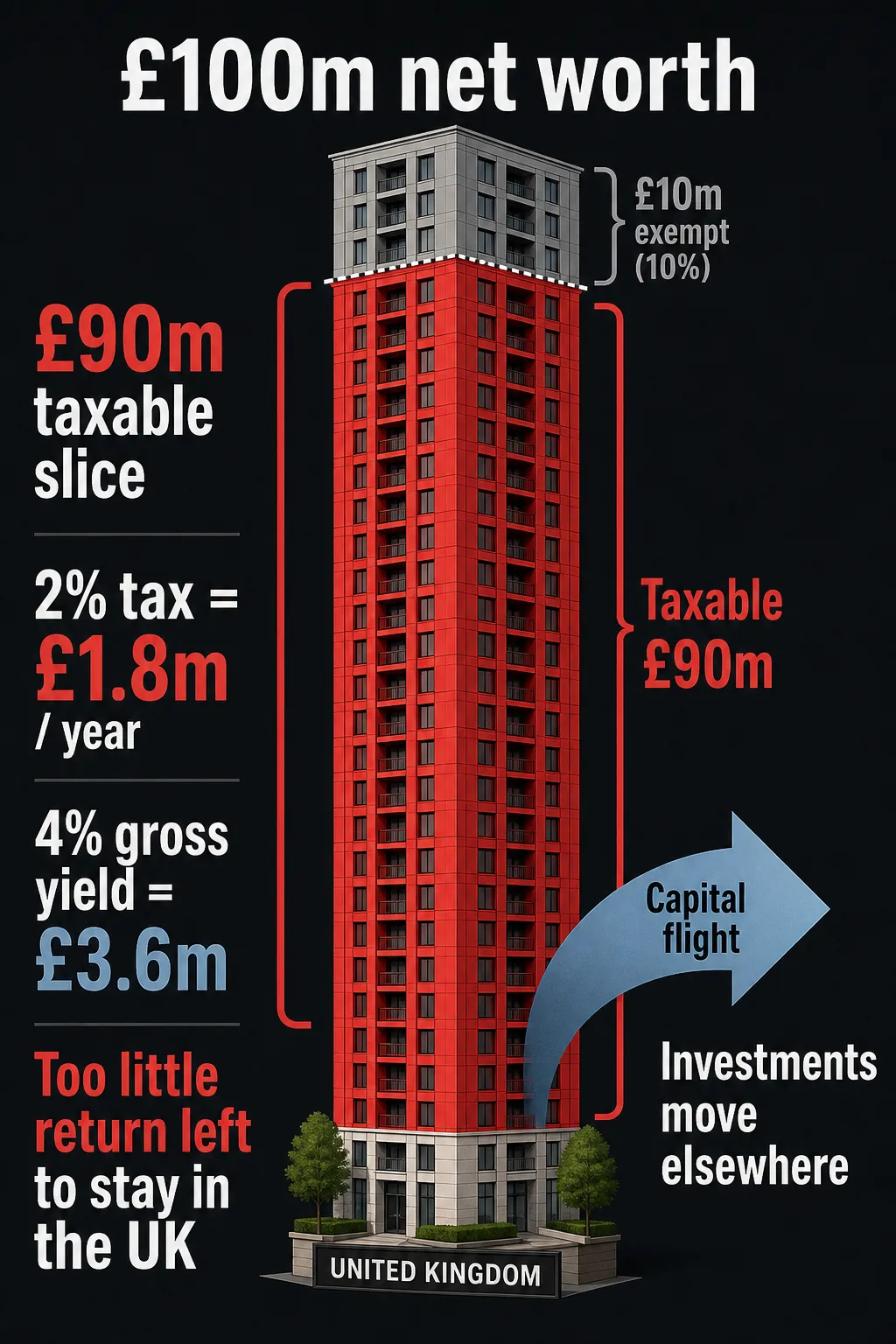
Credit to Daniel Priestley: the debate sounds abstract until you draw the stack.

Infographic: ยฃ100m net worth drawn as a tower. The top ยฃ10m is exempt; the ยฃ90m below is taxable. A 2% tax takes ยฃ1.8m a year, half of a 4% gross yield of ยฃ3.6m. An arrow labelled 'capital flight' shows investments moving out of the UK.
Our illustration. Assumes a 4% gross annual return on the taxable ยฃ90m, before income or capital gains tax.

The arithmetic

Net worthยฃ100m
Exempt (first ยฃ10m)ยฃ10m
Taxable sliceยฃ90m
2% wealth taxยฃ1.8m a year
4% gross yield on ยฃ90mยฃ3.6m a year

The tax takes half the gross return every year, before any income tax or capital gains tax. The stack is productive, but the saw takes a fixed slice regardless of whether it earned anything that year. In a bad year, the owner sells assets to pay it.

The counter-argument: very large fortunes have often grown faster than 4%, and some advocates argue a tax that bites into returns is the point. The question is where the capital goes next.

Daniel Priestley: the case against

An entrepreneur and author, and one of the most articulate critics of the wealth-tax-as-panacea school. His debate with Gary is essential viewing.

The evidence: videos and research

Titles are the creators' own. Several are firmly against a wealth tax, so read the research too.

So what would actually work?

Criticising a wealth tax is easy. Offering a better alternative is harder.

The evidence points one way: the problem isn't only how much we tax wealth, it's that we tax it in the wrong ways. A fairer system mostly means fixing the taxes we already have.

Reform property and land taxes

Land doesn't move. Council tax is still based on 1991 values, so a Band A flat can pay a higher effective rate than a Band H mansion. Tax lawyer Dan Neidle has set out how to scrap stamp duty and make council tax track current values.

Sources: Tax Policy Associates

Fix capital gains tax

The gap between income tax and capital gains rates is one of the biggest avoidance incentives in the system. Aligning the rates, with an allowance for inflation, raises more from wealth without valuing every asset every year.

Sources: Tax Policy Associates; Resolution Foundation

Reform inheritance tax properly

Business property relief, agricultural relief and trusts let the very wealthy pass on large estates with little tax. Fewer reliefs and a broader base would be fairer and could raise more.

Sources: IFS

Simplify the tax code

Tax rules are long and riddled with reliefs that large firms can exploit and small ones can't. (The often-repeated "10 million words, longest in the world" line is a myth: it counts guidance handbooks, not the law.) Fewer reliefs and a broader base level the field.

Sources: Office of Tax Simplification

Encourage entrepreneurship

Better SEIS and EIS relief, simpler R&D credits and less red tape for start-ups grow the pie. Taxing existing wealth only redistributes it.

Co-ordinate internationally

The OECD global minimum corporate tax (Pillar Two) is already in force. International co-operation on avoidance works better than a unilateral wealth tax that rewards leaving.

The question isn't "should the rich pay more?" It's "what tax design actually collects the money without driving away the thing you're trying to tax?" The answers are boring: fix property taxes, close loopholes, simplify the code. Boring answers don't make good thumbnails.Editorial opinion, Gary's Fairy Economics